

Dr. Leily Razavi, DDS
Cosmetic Dentist, Philadelphia
What Your Smile Is Doing to Your Mental Health
People don’t usually tell me the real reason they’ve come in. They say they want whiter teeth, or that a veneer chipped, or that they’ve been thinking about it for a while. But if I ask the right questions and give them enough time to answer, something else comes out.
A woman came in about eight months before her wedding. She was organized, calm, the kind of person who had everything handled. When I asked her to show me what she was hoping for, she pulled out her phone and scrolled through photos, inspiration shots, bridal looks, that kind of thing. Every single one was someone else. When I asked if she had any photos of herself smiling that she liked, she went quiet. She said she didn’t really take those.
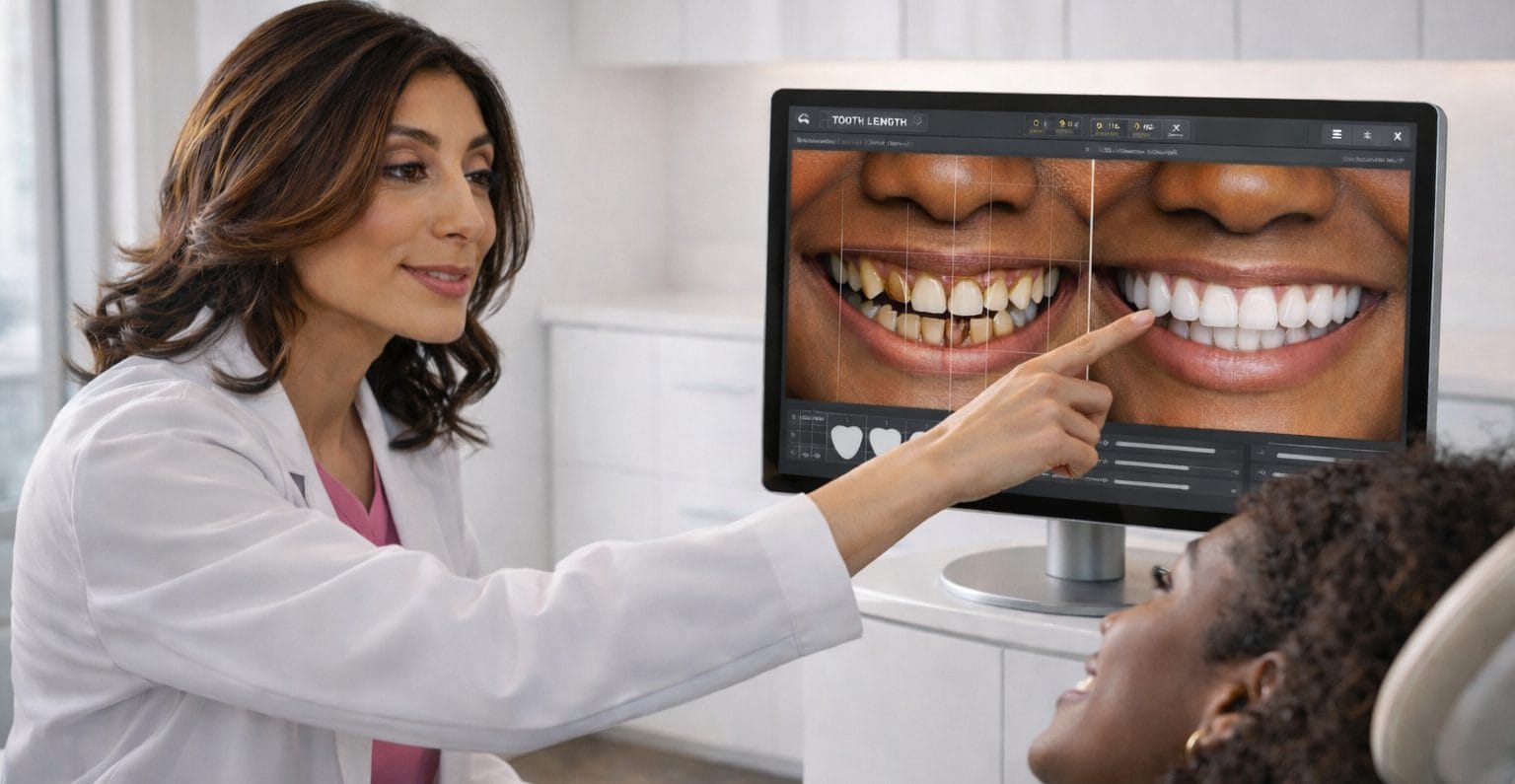
Dr. Razavi reviewing a Digital Smile Design preview with a patient
That is what brought her in. Not vanity. Not Instagram. Something quieter and more persistent than either of those things, a low-grade awareness that her smile was costing her something, and that she was tired of paying. I probably hear some version of that story once a week.
I’ve been practicing cosmetic dentistry in Philadelphia for over twenty years. I’ve seen this pattern more times than I can count, and the research is finally catching up to what clinicians have observed for a long time. The connection between dental appearance and mental health is real, it is measurable, and it matters.
The Research Is Serious
A 2026 study published in Frontiers in Psychology followed 300 patients seeking cosmetic dental treatment and measured their scores across four psychological dimensions: aesthetic anxiety, dental self-confidence, social influence, and self-esteem. Using two validated instruments, the Psychosocial Impact of Dental Aesthetics Questionnaire and the Rosenberg Self-Esteem Scale, researchers found significant correlations between dissatisfaction with dental appearance and lower self-esteem scores across all four categories. The smile line alone, meaning how much of the teeth and gums a person shows when they smile, was enough to produce measurable differences in how people felt about themselves. [1]
A 2025 study in BMC Psychology found that lower self-esteem was associated with a stronger interest in cosmetic dental treatment, regardless of whether someone had previous procedures. People who felt less confident in general were more likely to identify their smile as something they wanted to change. The relationship runs in both directions. Dental appearance affects self-esteem, and self-esteem shapes how people perceive their dental appearance. [2]
A separate 2025 study in Frontiers in Oral Health found that self-esteem functions as a mediating factor between dental confidence and overall wellbeing. People who feel bad about their teeth tend to feel worse about themselves in a broader sense, and that effect compounds over time. [3]
Frankly, I think we’ve undersold this for years. Dentistry got so focused on function that we forgot how much appearance costs people psychologically.
Smile Anxiety Is Real, and It's Getting Worse
There’s no clinical diagnosis called smile anxiety, but anyone who has ever held their hand in front of their mouth while laughing, untagged themselves from a photo, or turned down a speaking opportunity because they didn’t want to be seen on a screen knows exactly what it feels like.
Social media has made this harder. We are looking at ourselves more than any previous generation, in photos, on video calls, in the camera that opens by default when you turn your phone sideways. The BMC Psychology study specifically named social media as a measurable driver in the demand for cosmetic treatment. It is not that people are becoming more vain. It is that they are being confronted with their own image in high definition, constantly, and in contexts they cannot control.
Research published in PubMed in 2025 found that social anxiety had a measurable indirect effect on how people perceive their own dental and facial aesthetics, compounding the psychological burden for people who are already self-conscious in social situations. [4]
The behavioral signs of smile anxiety are worth naming because people often don’t recognize them as related to their teeth. Covering the mouth while laughing. Avoiding eye contact in photos. Smiling with lips closed even in moments of genuine happiness. Declining opportunities at work that involve public speaking or being on camera. Pulling back from social situations without fully understanding why. These aren’t small things. It’s how people quietly shrink their lives, and most of them don’t connect it to their teeth until someone asks.
What Actually Changes
When I use Digital Smile Design with a patient, something interesting happens before a single procedure begins. We build a digital preview of what their smile will look like, precise, customized, specific to their face. Patients see it and they go quiet for a moment. Sometimes they cry. Not because the result is dramatic, though it often is, but because they are seeing something they had stopped letting themselves imagine.
The clinical outcomes reflect what I see in the chair. Post-treatment scores on the same validated psychological instruments used in the research studies show statistically significant improvement in dental self-confidence, social functioning, psychological wellbeing, and aesthetic concern. These are not soft findings. They are reproducible across studies and populations.
My patient with the wedding sent me a photo after the ceremony. She was laughing, full teeth, completely unguarded. She looked like herself in a way she hadn’t in a long time.
When Something Else Is Going On
This is the part I think is important to say clearly. Cosmetic dentistry is not therapy, and I am not a therapist. Some patients come in with concerns that go deeper than what any procedure can address. Severe body dysmorphia, clinical depression, and significant social anxiety require a different kind of support, and part of my job in a consultation is listening for the difference between someone who wants to feel better in photos and someone who is suffering in a way that a new smile will not fix.
If a patient tells me that fixing their teeth will change everything, their relationship, their career, their fundamental sense of worth, I take that seriously. Sometimes that is the moment to have a different conversation. A good cosmetic consultation is not just about treatment planning. It is about understanding what a person actually needs.
What to Expect From a Real Consultation
A thorough cosmetic consultation should take time. It should cover your concerns, your medical and dental history, your goals, and what you’ve tried before. It should include imaging, and in my practice, a Digital Smile Design preview so you can see an accurate projection of your results before committing to anything.
I’ll be honest, the consultations I find most meaningful aren’t the complex cases. They’re the ones where someone finally says what they’ve been sitting with for a decade.
It should also include a dentist who listens. Not just to what you’re asking for, but to why you’re asking for it. The best outcomes I’ve seen, clinically and personally, come from patients who feel genuinely understood before treatment begins.
A Final Thought
The smile is where confidence lives for a lot of people. It is one of the first things others notice and one of the last things we feel fully comfortable showing. That is not a superficial concern. It is deeply human.
When someone walks out of my practice smiling without thinking about it, without covering their mouth or calculating the angle, that is the outcome I care about. Twenty years in, it still matters every time.
References
- [1] https://www.frontiersin.org/journals/psychology/articles/10.3389/fpsyg.2026.1745236/full
- [2] https://bmcpsychology.biomedcentral.com/articles/10.1186/s40359-025-02423-7
- [3] https://www.frontiersin.org/journals/oral-health/articles/10.3389/froh.2025.1681685/full
- [4] https://pubmed.ncbi.nlm.nih.gov/40495247/
About the Author
Dr. Leily Razavi, DDS
A cosmetic dentist in Center City Philadelphia, Dr. Razavi has been recognized as a Top Dentist by Philadelphia Magazine every year from 2020 through 2026. She practices at Razavi Dental, located at 1352 South Street.